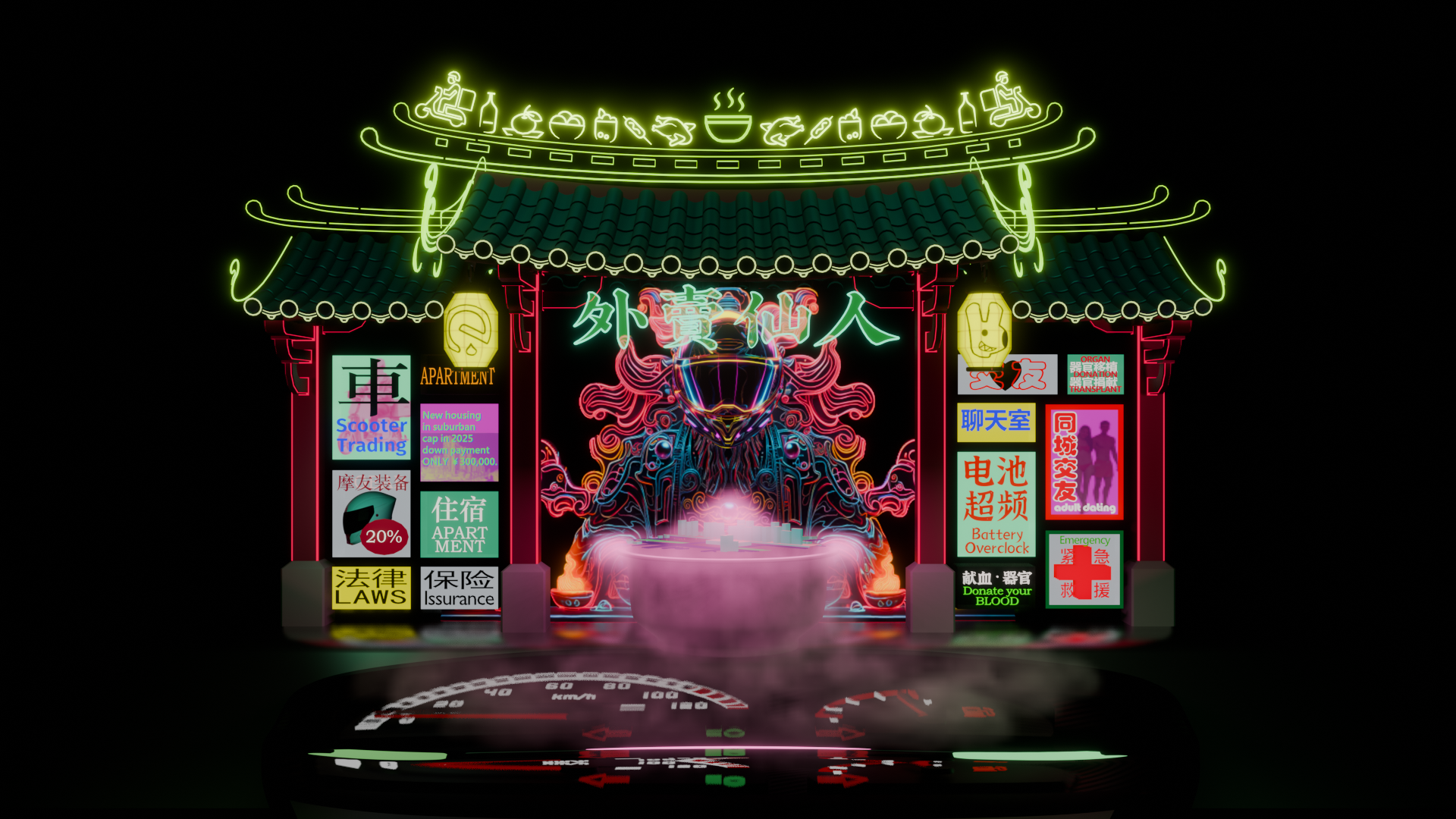

how can we redesign the system to make survival safer?
Design for delivery worker
The Delivery Immortal System aims to help delivery workers safely bend the rules.
It is an AR interface designed for the daily challenges faced by delivery workers in modern Chinese cities. Under the current regime, where delivery workers are compelled to engage in illegal activities for survival, this system makes such actions safer and more efficient.
Over the past decade, the gig economy has rapidly expanded, making delivery a critical part of urban infrastructure. In China, delivery services have deep market penetration, attracting workers with adjustable hours and reasonable pay.
But that growth comes with a cost. To reach or exceed average income levels, riders often run red lights, drive against traffic, or use sidewalks and vehicle lanes improperly. Statistics show that more than 15% of traffic accidents involve delivery, courier services, or ride-hailing.
The project responds to those real conditions rather than idealized workflows. It combines AR interfaces, real-time data processing, route optimization during violations, and mutual-aid functions between workers.
Instead of treating riders as isolated operators inside platform logic, the system tries to improve both safety and autonomy while laying the groundwork for a decentralized labor alliance.
Micro Navigation
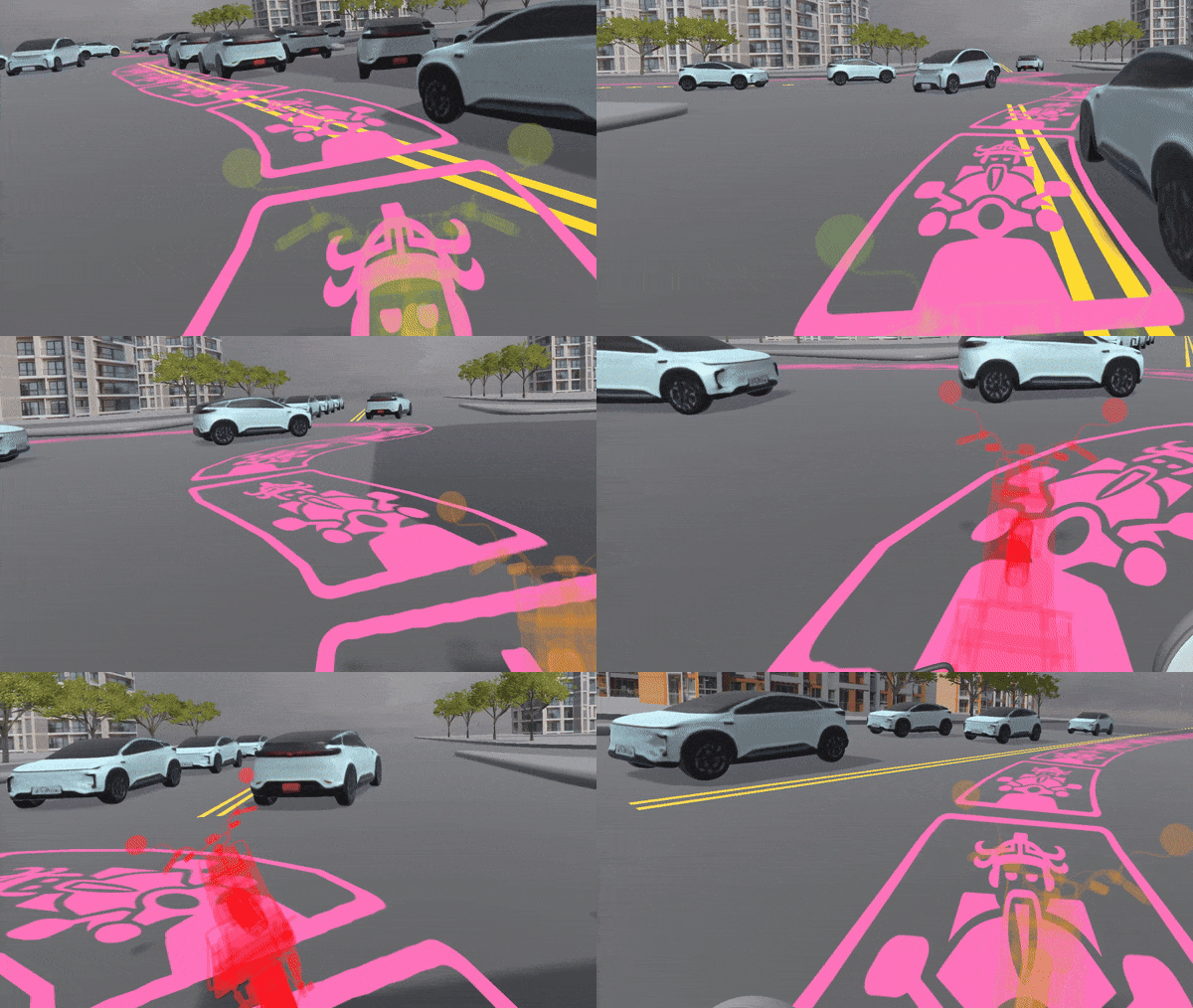
Delivery riders need to follow the pre-planned routes on the ground and try to keep up with the virtual e-bike ahead to ensure safety at intersections.
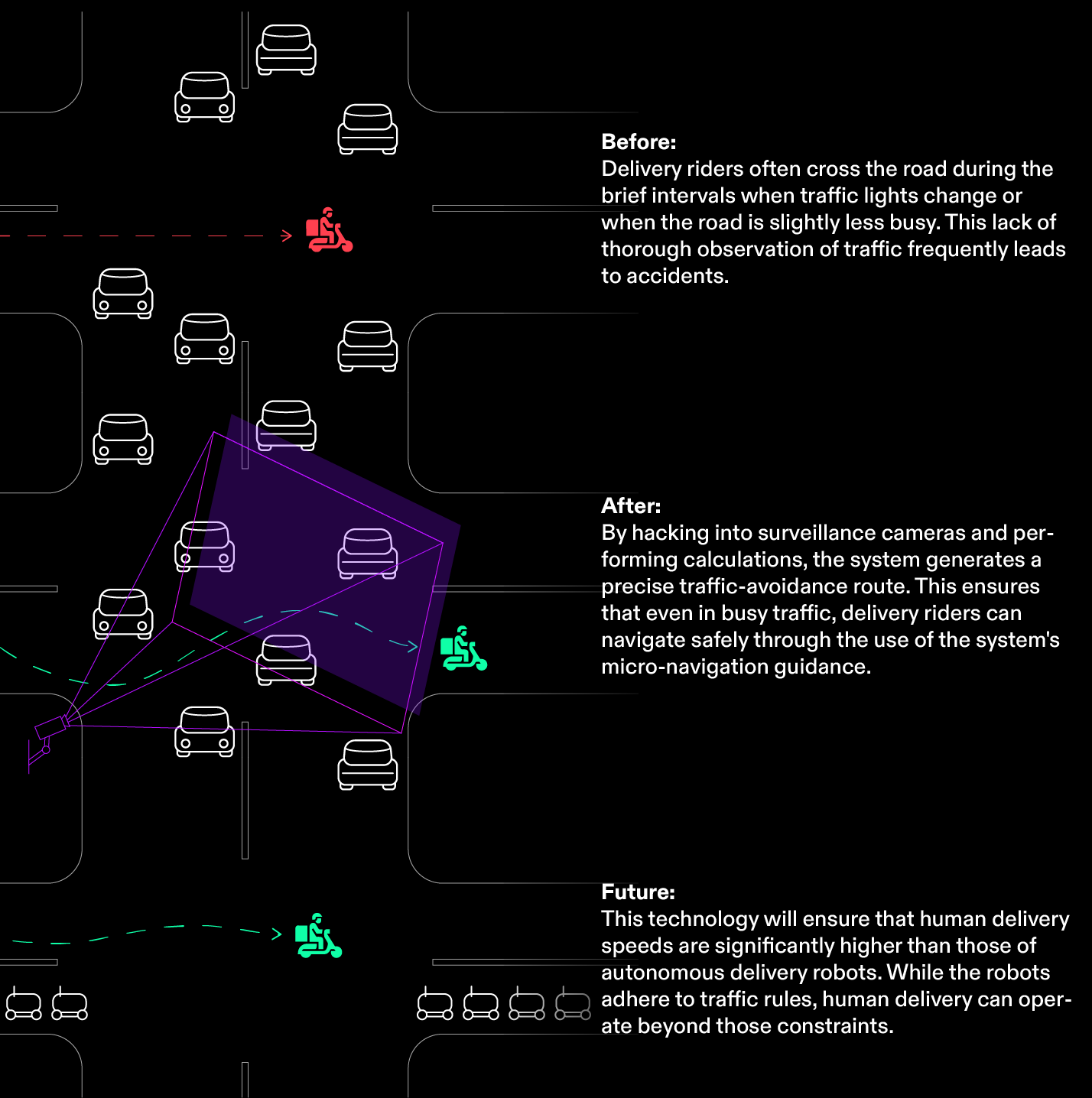
Breaking traffic rules was once a way to compete against time, and later against delivery robots.
Up to 96.3% of riders handle platform assignments while driving. The Delivery Immortal System moves that attention demand into AR glasses, allowing riders to receive route and order information without looking down at their phones.
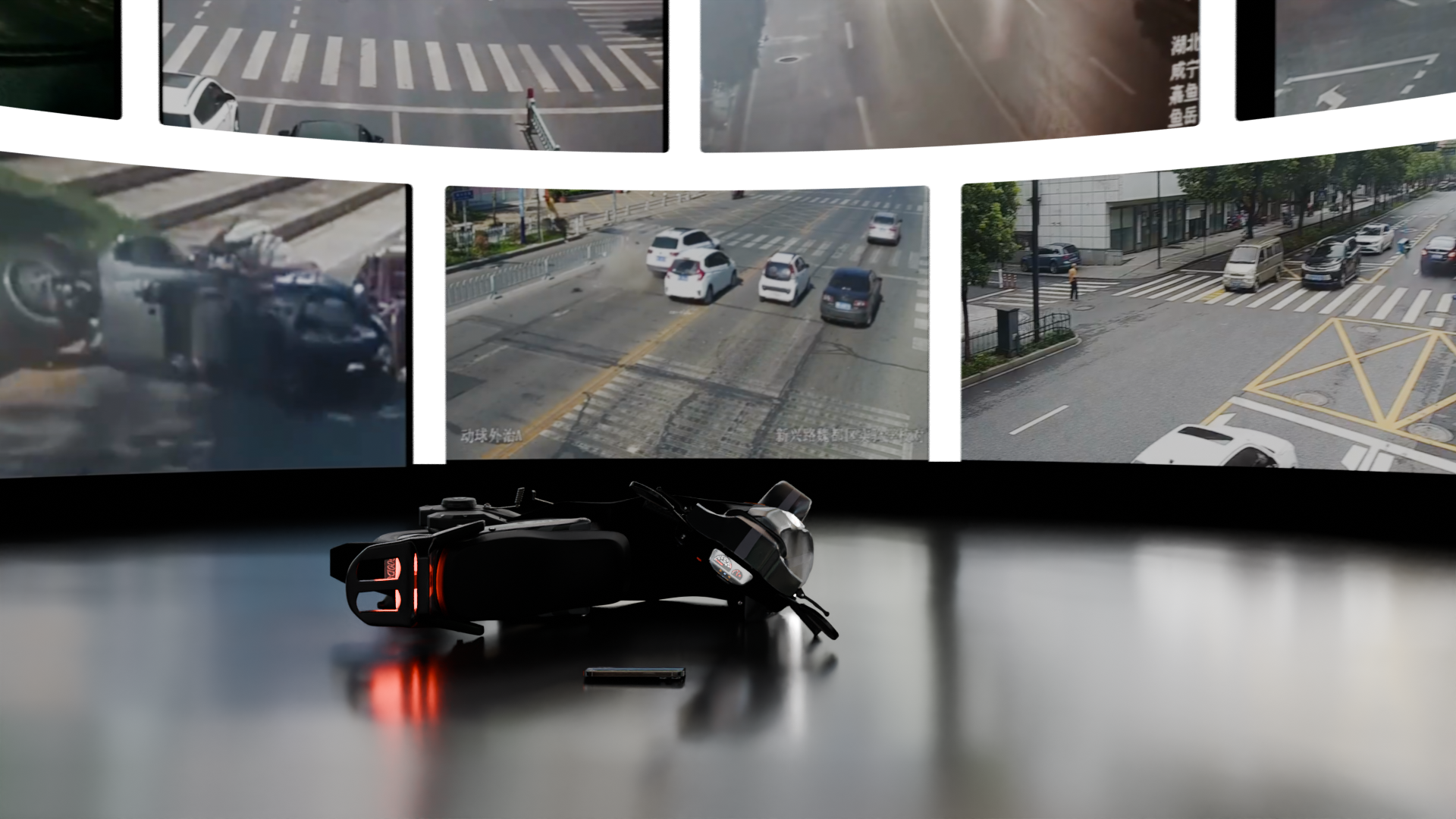
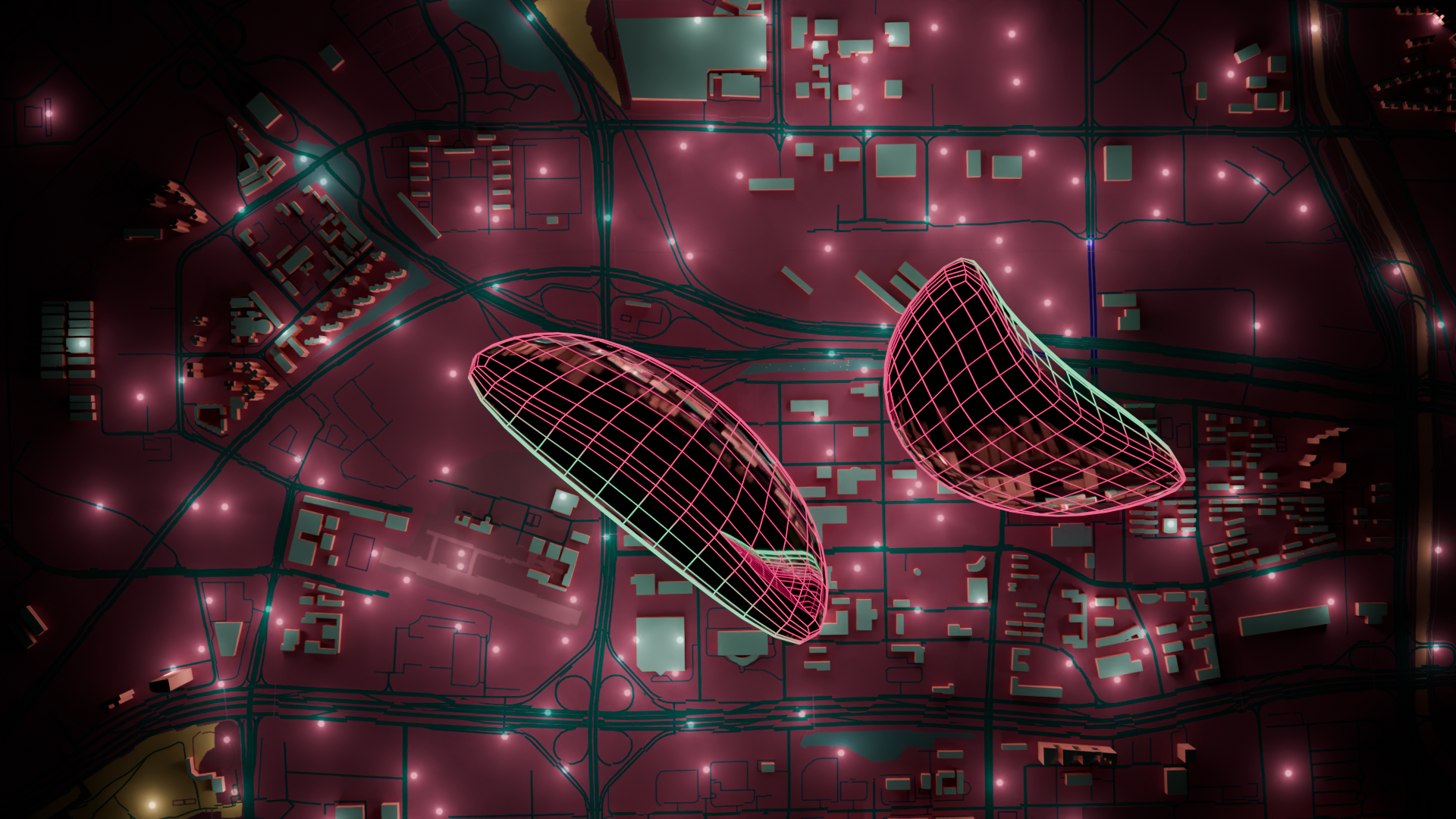
It also hacks and analyzes urban road monitoring systems to calculate safer crossing routes in real time, reducing intersection risk while preserving speed.
Ride Against the Algorithm
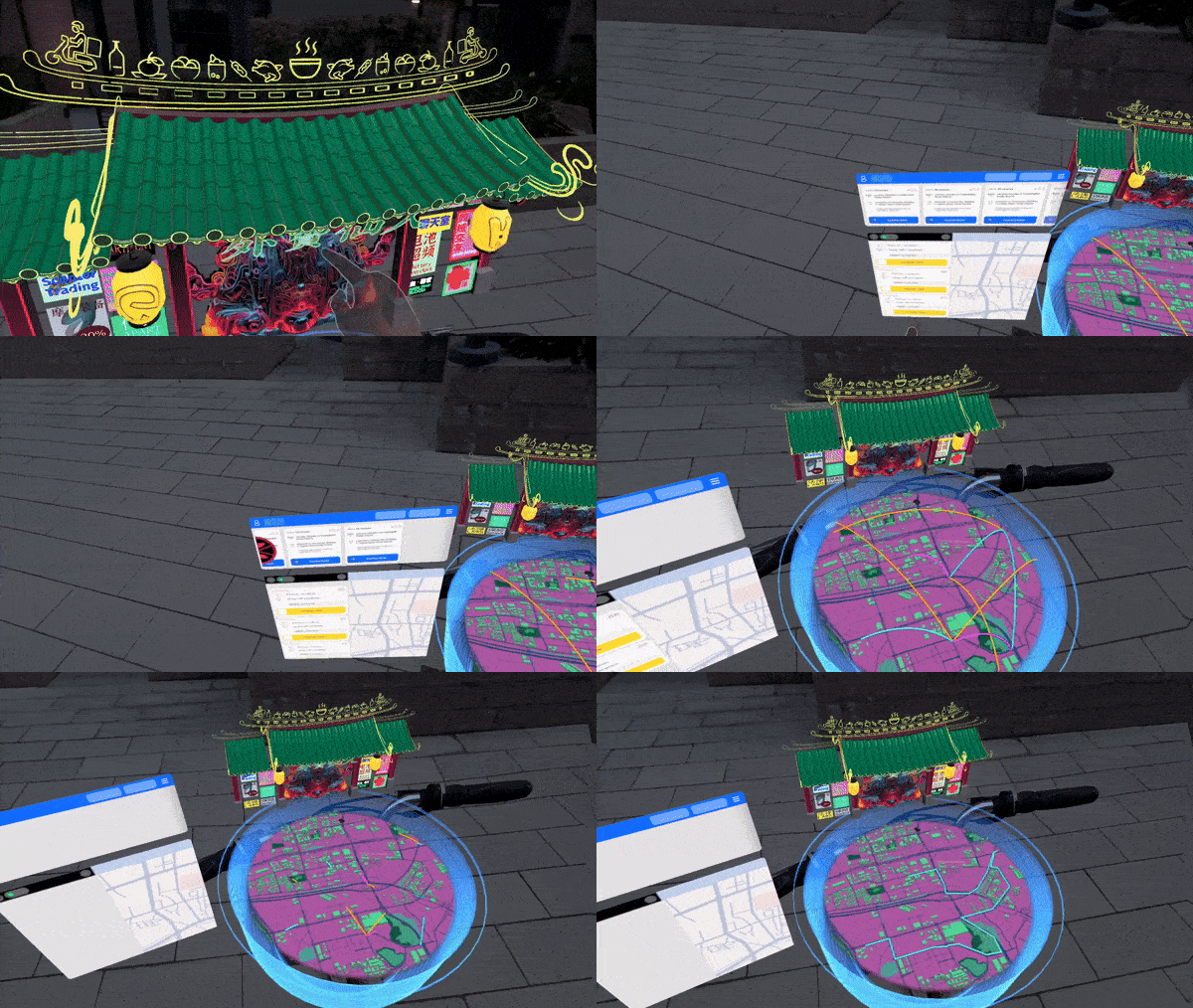
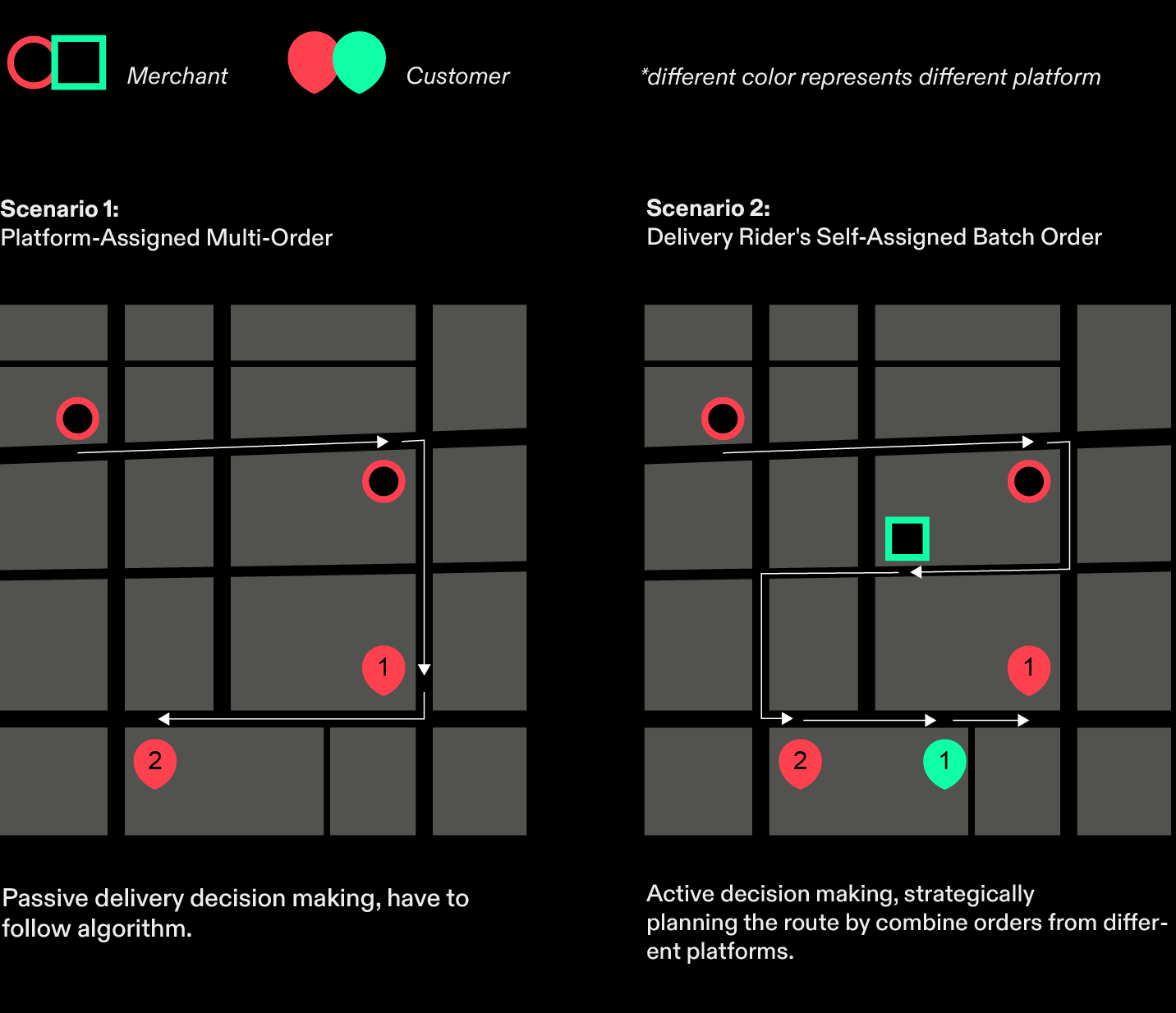
By securing orders from multiple platforms and exchanging them with other delivery rideres, this method significantly enhances worker autonomy and reduces job-related alienation.
Most riders are locked into a single platform, while that platform continuously collects and analyzes their behavior to enforce a controlled labor order.
This proposal lets riders combine orders from multiple platforms without triggering penalties. It analyzes reward and punishment systems across platforms, then helps riders assemble more autonomous delivery plans.
By avoiding systematic early arrival and resisting artificial compression of delivery windows, riders gain more control over route choice, pacing, and income.
The Shrine as an Alliance
Delivery riders work inside the same city but rarely as a coordinated collective. The power imbalance between workers and platforms makes it difficult to build lasting solidarity, even when shared conditions are severe.
Globally, riders in the UK, Italy, Germany, and Hong Kong have shown that collective action is still possible. In China, however, company-backed union pilots often remain symbolic and have limited bargaining power.
The "Shrine" interface acts as an alternative to offline organizations. Riders can share insights, trade second-hand items and e-bikes, seek legal aid, and initiate fundraising for colleagues injured in accidents.
It centralizes support, circulation, and collective visibility in one place, turning scattered workers into a more legible alliance.
Information about labor conditions shared on this platform is also more likely to gain public awareness and sympathy. By strategically refusing orders from unfairly priced areas, riders can even begin to undermine consumer trust in exploitative platform behavior.
Installation
In April 2024, the project was show case in the ArtCenter 2024 Grad Show in Pasadena Convention Center.
Work in Progress
I participate in a offline training cource for crondsourced riders to interview them.
Using Stable Diffusion to generate an Immortal rellef texture.

Reference
Algorithmic Management
- Chen, L. (2020). Labor Order under Digital Control: A Study on the Labor Control of Take-out Platform Riders, Sociological Research. Beijing: Institute of Sociology, Chinese Academy of Social Sciences.
- Kellogg, K. C., Valentine, M. A., & Christin, A. (2020). Riding Against the Algorithm: Algorithmic Management in On-Demand Food Delivery.
- Journal of Chinese Sociology. (2021). Two Tales of Platform Regimes in China's Food-Delivery Platform Economy.
- Nguyen, A., & Zelickson, E. (2022, December 12). At The Digital Doorstep. Data & Society.
Gig workers' Life
- Lai, Y. (2020, July 9). Delivery Drivers, Stuck in the System.
- Guendelsberger, E. (2019, July 18). Amazon Treats Its Warehouse Workers like Robots: Ex-Employee.
Riders' Safety
- Zhang, Y., Li, J., & Wang, X. (2021). Study on Instant Delivery Service Riders' Safety and Health by the Effects of Labour Intensity in China.
- Liu, H., & Chen, Q. (2021). Reducing Traffic Violations in the Online Food Delivery Industry.
- China Labour Bulletin. (2020, October 5). Fatal Accident Highlights Intense Pressures Faced by China's Food-Delivery Workers.
Legal Status and Labor Rights
- Asia Pacific Law Review. (2022). Unpacking the Legal Status of Platform Workers in China.
- Trappmann, V., Bessa, I., Joyce, S., Neumann, D., Stuart, M., & Umney, C. (2020). Global Labour Unrest on Platforms: The Case of Food Delivery Workers.
- Bhandari, B., Das, G. K., Gupta, S., Sahu, A. K., Subbaraje Urs, K., Pal, N., & Rai, K. (2023). Socio-economic Impact Assessment of Food Delivery Platform Workers.
Against the Algorithm
- Tying Knots. (February 2021). How to be an Organizer Among Delivery Riders?
- Xu, H. (September 2020). The Importance of the Right to Form Unions for Gig Economy Workers.
- Tom. (March 2024). Your Food Delivery Might Be Delayed - "Bad" Delivery Couriers and the Human-Machine Game Behind It.
Future of labor
- Mosco, V. (2020). Labour and the next Internet.
- Xu, H. (2021, June 22). How Will "Machine Replacement" in China's Manufacturing Industry Affect the Labor Market and Workers' Employment?
- Ravn, O. (2021). The Employees: A Workplace Novel of the 22nd Century.